In Winnr go to Email Users → Export, choose Salesforge, click Export, then Download CSV. In Salesforge, open Email Accounts and use the bulk (CSV) connect option to upload the file. The file is separated by semicolons, not commas, and its trackingDomain column is filled with each mailbox's domain, so replace or clear it before upload.
Salesforge is an AI cold-email platform that connects any SMTP/IMAP mailbox and adds AI copy and sequencing on top. Winnr provisions and warms the mailboxes; Salesforge sends the campaigns.
What's in the Salesforge file
Columns are separated by semicolons (;), not commas.
| Column | What Winnr puts in it |
|---|---|
| address | The full email address |
| firstName | First word of the display name |
| lastName | Rest of the display name |
| imapHost | That mailbox's mail server |
| imapUsername | The full email address |
| imapPassword | The mailbox password |
| imapPort | 993 (SSL) |
| smtpHost | That mailbox's mail server |
| smtpUsername | The full email address |
| smtpPassword | The mailbox password (same as IMAP) |
| smtpPort | 465 (SSL) |
| signature | The mailbox's footer, usually empty |
| trackingDomain | The mailbox's own domain (replace or clear it) |
Check before you upload
- Separator. Keep semicolons. A file re-saved with commas will not parse as Salesforge's layout.
- trackingDomain. Replace each value with the tracking hostname you set up, or clear the column. A plain sending domain that does not point at Salesforge's tracking breaks open and click tracking.
- signature. Usually empty. Add signatures in Salesforge after import, or fill the column first.
- No daily limit column. Set the limit in Salesforge after import.
Daily limit in Salesforge
The Salesforge file carries no limit, so set it per mailbox after connecting: 10 to 20 cold emails per mailbox per day (15 is a good default), and keep each mailbox's total, cold plus warming, at 50 or under. Warm new mailboxes for at least two weeks before they send cold.
What's next
Step-by-step
-
1. Select the mailboxes in Winnr
Open Email Users and tick the mailboxes you want in Salesforge. To take one domain, filter by it and tick the header checkbox. With nothing ticked, the export includes every mailbox in your account.
-
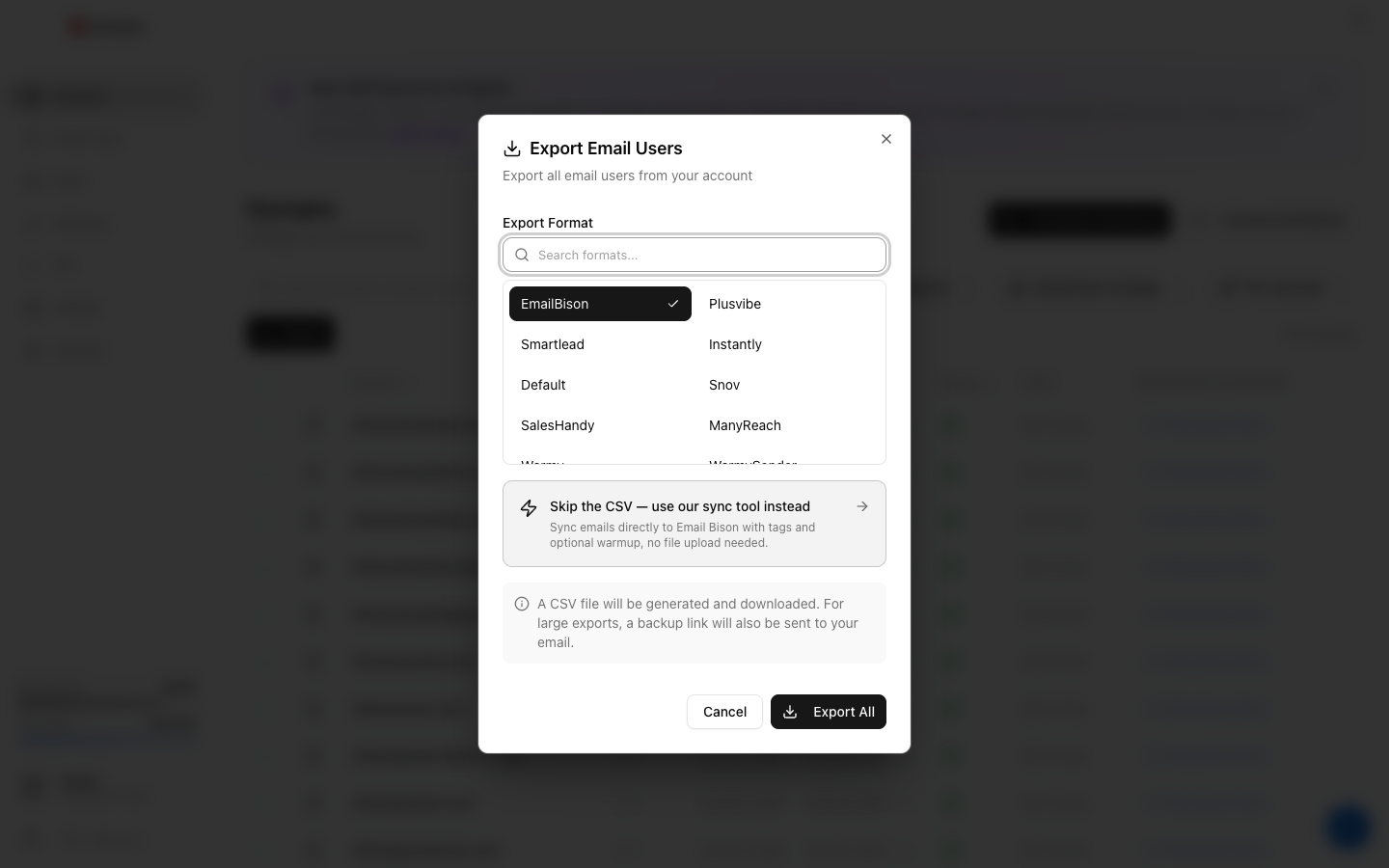
2. Export in the Salesforge format
Click Export, choose Salesforge under Export Format (the search box finds it quickly), then click the Export button.
-
3. Download the CSV
Click Download CSV. The link lasts 15 minutes, so export again if it has expired. The file holds passwords in plain text, so keep it private.
-
4. Check the tracking domain
The trackingDomain column is filled with each mailbox's domain. Change it to the tracking domain you set up for Salesforge, or clear it if you have not set one up. Save the file with semicolons as the separator.
-
5. Upload to Salesforge
In Salesforge, open Email Accounts in your workspace and use the bulk (CSV) connect option to upload the file.
-
6. Confirm every mailbox connected
Check every mailbox shows as connected before adding it to a sequence.
Frequently asked questions
Why does the file look like one column in my spreadsheet app?
It uses semicolons as the separator. Import it into your spreadsheet as semicolon-separated, or upload it to Salesforge without opening it.
I edited the file and now Salesforge rejects it. Why?
Some spreadsheet apps save CSV with commas by default. Save it again with semicolons as the separator, or re-export from Winnr and make your edits in a plain text editor.
How do I set up a tracking domain?
Add the CNAME Salesforge asks for on the domain in Winnr (Domains → the domain → DNS Records), then put that hostname in the trackingDomain column.
Should I use Salesforge's warmup or Winnr's?
Pick one per mailbox. Winnr's built-in warming is $0.60 per mailbox per month; if you use it, keep Salesforge's warmup off so the mailbox is not warmed twice. The file has no warmup column, so check the setting after import.
Can I mix Winnr mailboxes with Salesforge's own mailboxes?
Yes. Salesforge connects any SMTP/IMAP mailbox, so Winnr mailboxes can sit alongside others in the same workspace.
A mailbox fails to connect in Salesforge. What now?
Check imapPassword and smtpPassword for that row. A password changed in Winnr after you exported will not match the file. Export that mailbox again and re-upload it. If a fresh export still fails, see the mailbox authentication troubleshooting guide.